From “Maiden Aunts” to “Virtuous Renouncers”: Changing Opportunities for Buddhist Nuns in Nepal
Mentor: Suzanne Bessenger, Religious Studies
Students: Delaney Scott, Kai Miller, and Jordyn Shumpert
Project Abstract
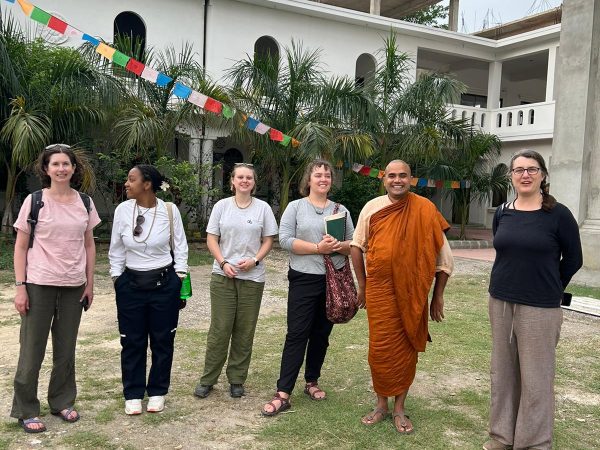
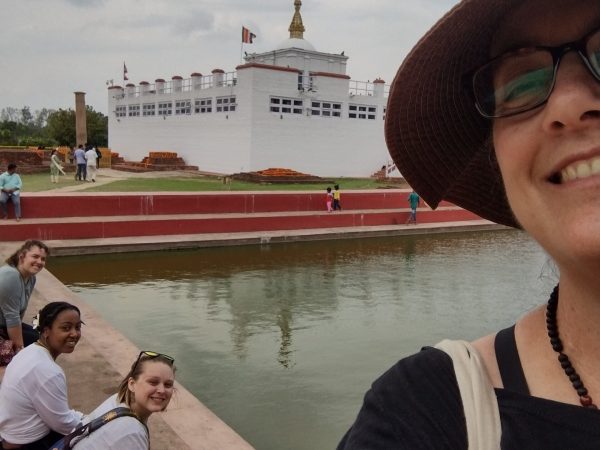
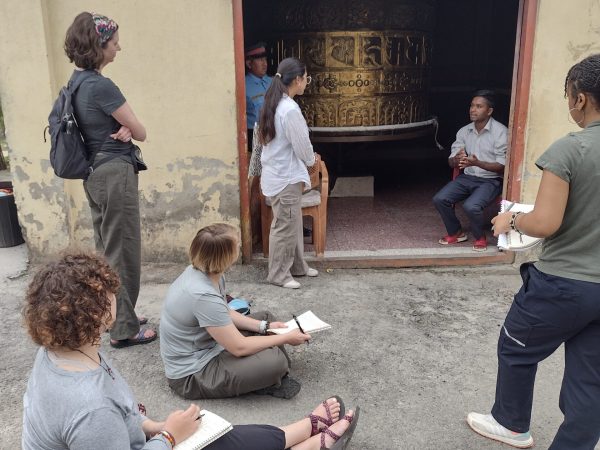
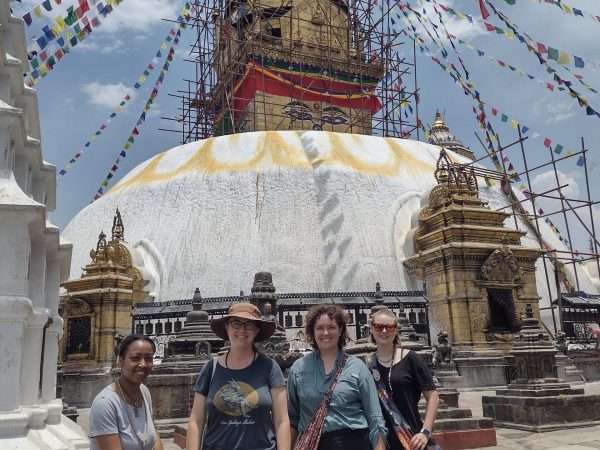
Before leaving the U.S., we hosted a screening of the Tibetan activist and filmmaker Ngawang Choepel’s film Ganden: A Joyful Land, a film about a famous monastery in Tibet, its re-establishment in exile in India, and the effect of the institution’s transformation on Tibetan Buddhist monastic life. We hosted Ngawang Choephel at Randolph College for two days, and our research team took him to dinner before the film screening to ask him about his thoughts on the state of contemporary Buddhism and monastic life. Students spent time in Kathmandu, Lumbini, and Namo Buddha, Nepal, asking questions raised by readings done prior to the trip. Students developed relationships with monks, nuns, laymen, and laywomen, in which they were able to exchange views not only of nuns’ changing educational opportunities, but also a variety of related topics that were interest to both students and their interlocutors– logic, karma, the afterlife, the value of religion, the value of monasticism, the difference between “east” and “west”, how education is different in American and Nepali schools, and in Nepali secular schools and Buddhist monastic institutions, the purpose of ordination, the purpose of monastic education, and the value of temporary ordination. All of the above activities challenged students’ assumptions and prior learnings about the secular/religious divide, the role of monasticism in society, the reasons people ordain as Buddhist monastics, and the role that education plays in both secular and religious contexts.
Delaney Scott
The exposure to a culture such as Nepal’s, which has drastically different healthcare practices than what we have here, encouraged me to incorporate this kind of research into my studies. It made me realize the subjectivity of common healthcare ethics and how crucial it is to have a proper understanding of the different perspectives. It’s also important to note that my studies in Nepal pertain to my gender studies here and that using the research I conducted in my communication with the school helped earn me a research position that pays tuition. Studying in Nepal has inspired me to try and do more research abroad while I continue my education so that I can eventually have a career as a clinical ethicist with a well-rounded background in cultural studies.
Kai Miller
I think this trip was truly a life-changing experience and I would like to go back one day and spend a longer time there hopefully expanding my knowledge and understanding of Nepal as well as our research. I am interested in going back to Nepal and connecting with some of the people I met and joining them in some of the social services work they are conducting there. I am specifically interested in looking into some of the environmental and political policies and how these affect the locals.
I am interested in doing some work in Nepal that has to do with improving the lives of the locals in terms of environmental and economic standings. I have also been using the experiences and skills I gained in Nepal to acquire possible job opportunities in similar fields. I was recently offered to work at the Henrico Education Foundation in my hometown of Richmond, Virginia: the founder of the organization admired the work we conducted in Nepal and said that my skills would be a great asset to their team. Although I’m not 100% sure if this is something I’d be interested in, I would like to do something where I can use the skills I gained.
Jordyn Shumpert
As frivolous as this may sound after such an experience as my stay in Nepal, this project taught me how to travel for work and adapt to new environments quickly. I had had no experience outside of the country, barring a couple-hour excursion to Mexico on a cruise, so I was walking into international travel and very new cultural expectations without any personal experience to inform me. While I think this helped me learn not place stereotypes or specific expectations on the areas and people we were visiting and speaking to. It also made me build a toolbox of social skills. Observation, adaptability, and self-advocacy were imperative to this trip, and I left Nepal with a newfound confidence in traveling and seeking out opportunities to learn in unfamiliar areas.